
4. Steady one-dimensional flow in coastal aquifers#
The salinity (\(C_s\)) of groundwater in coastal aquifers ranges from almost zero for freshwater to \(C_s = 36\) g/L for intruded seawater. Because freshwater has a lower density (\(\rho_f = 1000\) kg/m\(^3\)) than seawater (\(\rho_s = 1025\) kg/m\(^3\)), fresh groundwater tends to float on top of saline groundwater. The water density \(\rho\) at 20\(^\circ\) may be computed from the salinity using the empirical formula
where both \(C_s\) and \(\rho\) are in kg/m\(^3\). This approximation is reasonable for salt concentrations up to the salinity of seawater.
In coastal aquifers, the freshwater is separated from the saltwater by a brackish transition zone. When the transition zone is relatively thin, that is, much thinner than the thickness of the freshwater lens, it can be approximated by an interface. An interface is a boundary between fluids that do not mix. Replacing the transition zone (in which there is mixing) by an interface greatly simplifies the mathematical treatment of variable-density flow problems and provides a means to develop analytical solutions for coastal aquifer flow. The location where the interface is at the top of the aquifer is called the tip of the interface, while the point where the interface is at the bottom of the aquifer is called the toe of the interface (Figure 4.1).
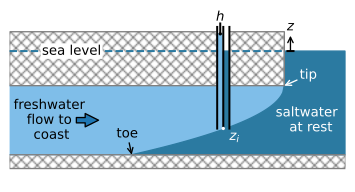
Figure 4.1 Steady interface in a coastal aquifer, where \(h\) is the head in the freshwater zone above sea level and \(z_i\) is the elevation of the interface with respect to sea level.#
Steady interface flow means that the interface has reached a steady-state position, the saltwater is at rest, and only the freshwater is flowing. When the saltwater is at rest and an observation well is screened in the saltwater, the saltwater rises to exactly sea level; this is called the saltwater head. As the saltwater is not flowing, the saltwater head in the saltwater is the same everywhere. After all, Darcy’s law states that water moves from a high head to a low head. When the Dupuit approximation is adopted for flow in the freshwater zone, the depth of the interface may be computed from the head in the freshwater as explained in the following.
Consider steady interface flow as depicted in Figure 4.1. The elevation of the interface \(z_i\) is measured with respect to sea level (i.e., \(z_i\) is negative). An observation well has its opening at the interface and is filled with freshwater. The freshwater rises to elevation \(h\) above sea level so that the pressure \(p_f\) at the bottom of the observation well is
where \(\rho_f\) is the density of freshwater. Just to the right of the freshwater observation well is a second observation well, which also has its opening at the interface but is filled with saltwater. The saltwater in the second observation well rises up to sea level (\(z = 0\)) (Figure 4.1). The pressure \(p_s\) at the bottom of the second observation well is
The pressures at the bottoms of both observation wells must be equal (\(p_f=p_s\) since they are at the same elevation and the interface is not moving). Setting Eq. ((4.2)) and Eq. ((4.3)) equal and rearrangement of terms leads to an expression for the elevation of the interface \(z_i\) as a function of the head \(h\) above sea level in the freshwater
where
Relation ((4.4)) is known as the Ghyben-Herzberg equation (e.g., Post et al., 2018).
Using the density values for freshwater and seawater provided above gives \(\alpha=40\). In words: If the head in the freshwater at a location is 1 m above sea level, the steady interface at that location is 40 m below sea level.
Note that the Ghyben–Herzberg relation holds for the case that the freshwater flow is steady and the saltwater is at rest. The head \(h\) in Eq. ((4.4)) is the head in the freshwater at the interface. When the Dupuit approximation is adopted (i.e., the resistance to flow in the vertical direction is neglected and the vertical head distribution is approximated as hydrostatic), the elevation of the interface may be computed from the head at any elevation in the freshwater with the Ghyben–Herzberg equation ((4.4)).